
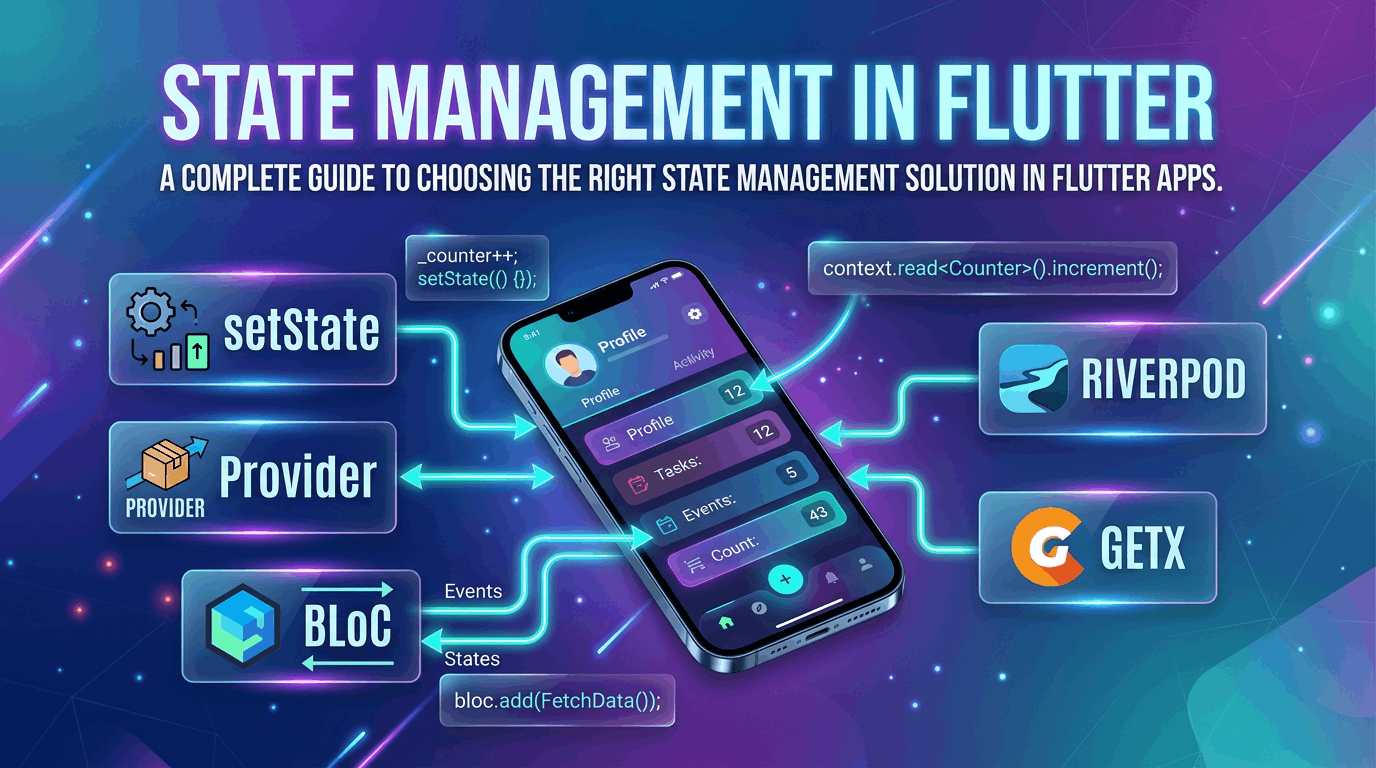
📌 Introduction
One of the most important decisions in Flutter development is choosing the right state management approach. As your app grows, simple solutions like setState() are no longer enough.
⚡ What is State Management?
State management is how your app stores, updates, and shares data across UI components.
Simply put: State = data that changes over time
🚀 Why State Management Matters
- ❌ Without it: messy UI and bugs
- ✅ With it: clean architecture and predictable UI
- 🚀 Better performance and scalability
🧩 Types of State in Flutter
🟢 Local State
- Inside a single widget
- Example: toggle button, checkbox
- Managed by setState()
🔵 Global State
- Shared across multiple screens
- Example: user login, cart data
- Needs advanced state management
🔍 Popular State Management Solutions
🔸 setState()
Good for small apps but not scalable.
🔸 Provider
Official Flutter solution, simple and widely used.
🔸 Riverpod
Modern, testable, and more flexible than Provider.
🔸 Bloc / Cubit
Best for large-scale enterprise apps with strict architecture.
🔸 GetX
Lightweight, fast, and popular for quick development.
⚖️ Comparison Table
| Solution | Learning Curve | Scalability | Boilerplate |
|---|---|---|---|
| setState | Easy | Low | Low |
| Provider | Medium | Medium | Medium |
| Riverpod | Medium | High | Medium |
| Bloc | Hard | High | High |
| GetX | Easy | High | Low |
🏗️ Real-World Scenario
Imagine building an e-commerce app with:
- Cart system
- User authentication
- API integration
- Multiple screens
🧠 How Senior Developers Think
- They design architecture first
- They choose tools based on scalability
- They separate UI and business logic
- They plan for long-term maintenance
🎯 Best Practice Strategy
- Small apps → setState
- Medium apps → GetX / Provider
- Large apps → Bloc / Riverpod + Clean Architecture
⚠️ Common Mistakes
- ❌ Using setState everywhere
- ❌ Mixing UI with business logic
- ❌ No separation of layers
- ❌ Overengineering small apps
🎉 Conclusion
State management is not just a tool — it is the foundation of scalable Flutter applications. Choosing the right approach will directly impact your app’s success.